Nigeria’s 2026 Cloud Computing Guideline: 5 Things Every Nigerian Should Know

Cloud computing may sound like a topic for IT professionals, government agencies and technology companies.
But Nigeria’s new National Cloud Computing Guideline 2026 also concerns something much closer to everyday life: how government services operate, how different types of data are handled, and the digital infrastructure Nigeria is building for the future.
The Guideline was approved on 4 August 2026 and becomes effective on 1 January 2027.
So, what does it actually mean for Nigerians?
Here are five things worth knowing.
1️⃣ More government services are expected to move to the cloud
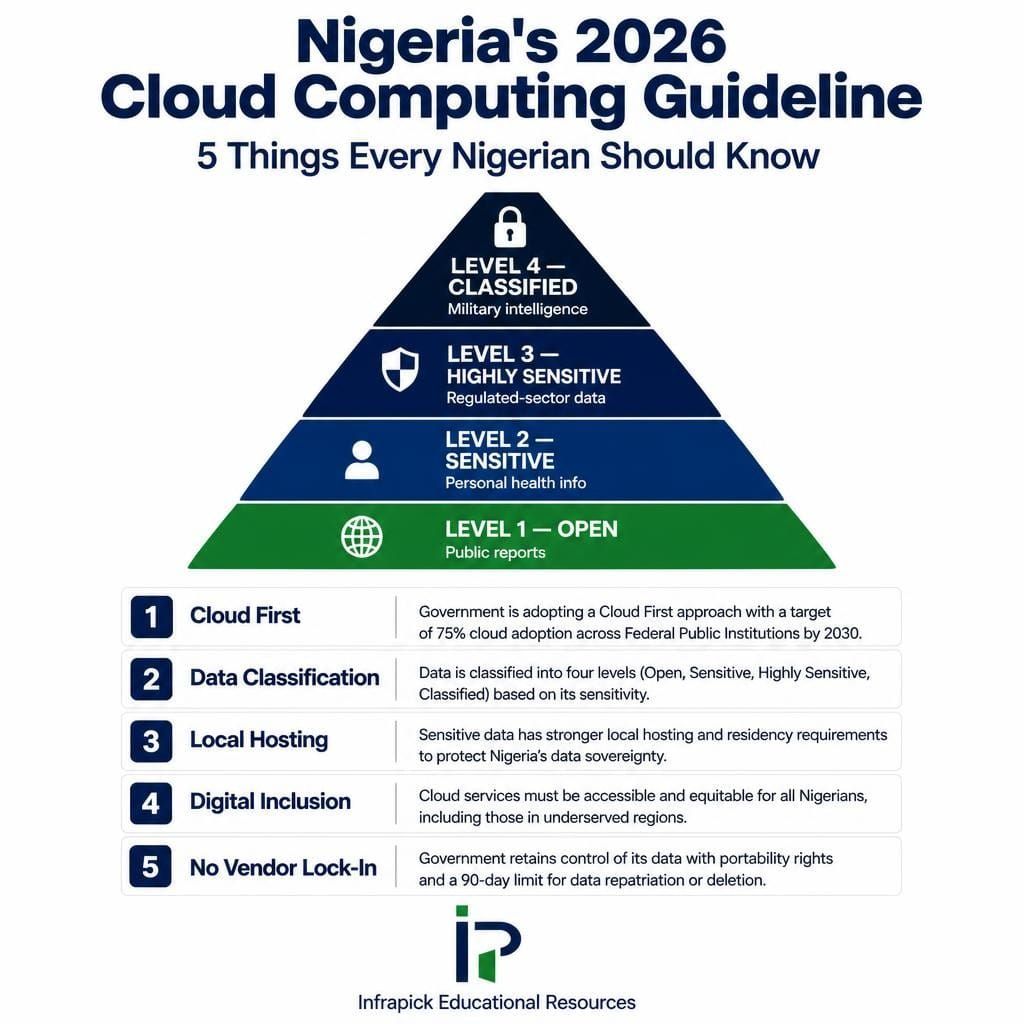
Nigeria is adopting a Cloud First approach for Federal Public Institutions.
This means that when federal institutions procure or deploy new IT resources, cloud-based solutions should become the preferred option unless there is a documented reason to use something else.
The Government has set a target of 75% cloud adoption across Federal Public Institutions by 2030.
For citizens, the technology itself is not necessarily what matters. What matters is what it is expected to enable: more modern digital public services, greater efficiency and infrastructure that can scale as more services become digital.
2️⃣ Not all your data will be treated the same way
One of the most important parts of the Guideline is Nigeria’s National Data Classification Framework.
Government, citizen, corporate and regulated-sector data covered by the framework must be classified according to its sensitivity. The framework establishes four levels:
Level 1 — Open
Examples include open government data and public reports.
Level 2 — Sensitive
This includes personal health and social information.
Level 3 — Highly Sensitive
This includes sensitive personal information and certain regulated-sector data.
Level 4 — Classified
This covers areas such as military intelligence, critical national infrastructure information and strategic national secrets.
The sensitivity of the information determines how and where it should be hosted and protected.
3️⃣ Sensitive data gets stronger local hosting requirements
The more sensitive the data, the stronger the hosting and residency requirements become.
For example, Level 2 data is to be hosted within Nigeria by default, while cross-border hosting requires prior NITDA authorisation and other safeguards.
Level 3 data is primarily expected to remain within Nigeria in private or secure hybrid cloud environments.
And Level 4 classified information has much stricter requirements: it must be hosted within Nigeria in approved environments such as government infrastructure, colocated private Data Centers or NITDA-certified private cloud infrastructure.
So when people talk about data sovereignty, this is one way it becomes tangible. It is not simply about saying that Nigerian data should remain Nigerian. It is about defining which data needs stronger protection, where it can be stored and under what conditions it may leave the country.
4️⃣ Moving government services to the cloud should not leave parts of Nigeria behind
Cloud adoption is useful only if people can actually access the services. The Guideline therefore requires cloud services to be designed and deployed with universal accessibility and equitable service availability in mind.
It specifically states that cloud deployments should not create barriers for people living in underserved or disadvantaged regions. This is an important point.
Nigeria’s digital transformation cannot simply mean better digital services in locations where connectivity is already strong.
The infrastructure supporting those services also needs to work for citizens outside the country's best-connected areas.
5️⃣ Government should retain control over its data — even when changing cloud providers
Moving government systems to the cloud creates another risk: becoming too dependent on one provider. The Guideline addresses this through requirements around data portability and vendor lock-in.
Cloud contracts must include arrangements allowing government data and applications to be transferred when changing providers.
Government and regulated-sector entities also retain ownership of their data, and contracts must establish a process for its secure repatriation, transfer or deletion when a service ends — within a maximum timeline of 90 days.
For citizens, this matters because public data should not effectively become trapped within the technology of one private provider.
THE BIGGER PICTURE
Most Nigerians will probably never need to know which cloud platform hosts a government application or which Data Center stores a particular workload. But they will experience the consequences.
When you access a government service online, submit information digitally or interact with an increasingly digital public sector, there is physical infrastructure behind that experience. Data Centers> Networks> Cloud infrastructure > Power > Cybersecurity systems.And increasingly, AI infrastructure.
Nigeria’s 2026 Cloud Computing Guideline is therefore about more than moving government IT systems to the cloud. It is part of a much bigger question: What digital infrastructure does Nigeria need to support its citizens, economy and digital ambitions over the next decade?
That is a conversation worth making accessible beyond the technology industry.
Source: National Cloud Computing Guideline 2026 — National Information Technology Development Agency (NITDA).
RELATED EDUCATIONAL RESOURCE
NEED SUPPORT WITH YOUR INFRASTRUCTURE PROJECT?
Turn your infrastructure challenge into a clear next step.
Whether you are selecting a Data Center, planning capacity or site expansion, improving infrastructure visibility, assessing a market or facing a specific technical challenge, Infrapick provides independent expertise and actionable intelligence to help you move forward with confidence.
ABOUT THE AUTHOR
A telecommunications engineer by training, Azimath Olayemi Adjassa has spent more than twelve years working across digital infrastructure, telecommunications and critical environments. Her areas of interest include the intersection of connectivity, Data Centers, digital sovereignty and artificial intelligence.
She is a Data Center consultant and the founder of Infrapick, an advisory practice specializing in Data Center hosting decisions and capacity intelligence within the African infrastructure ecosystem. Her approach combines supporting organizations in making informed hosting decisions with improving the visibility of available infrastructure capacity for operators.
Her ambition is to bridge the gap between user requirements and the operational realities of the industry, while contributing to a more transparent and accessible market—one where investment, hosting and development decisions are driven by reliable data and a shared understanding of critical infrastructure challenges.