CLOUD SOVEREIGNTY OR AI SOVEREIGNTY? USE CASE #5 — SOUTH AFRICA: DOES AFRICA ALREADY HAVE AN AI-READY ECOSYSTEM?

Discussions around digital sovereignty in Africa often focus on the fast-growing markets of West Africa or on the emerging digital ambitions of countries across the continent.
But another question deserves attention:
Does Africa already have a country where most of the conditions required for a mature AI ecosystem are in place?
South Africa is arguably the strongest candidate.
The country combines:
· Africa’s largest Data Center market;
· multiple hyperscale Cloud regions;
· internationally recognised universities;
· a sophisticated financial sector;
· a relatively mature technology ecosystem;
· strong demand for digital services.
South Africa remains Africa's primary Data Center hub and hosts Cloud regions from major global providers including AWS, Microsoft and Google.
The purpose of this assessment is therefore to determine whether South Africa has reached a level of maturity where AI can become the next strategic priority.
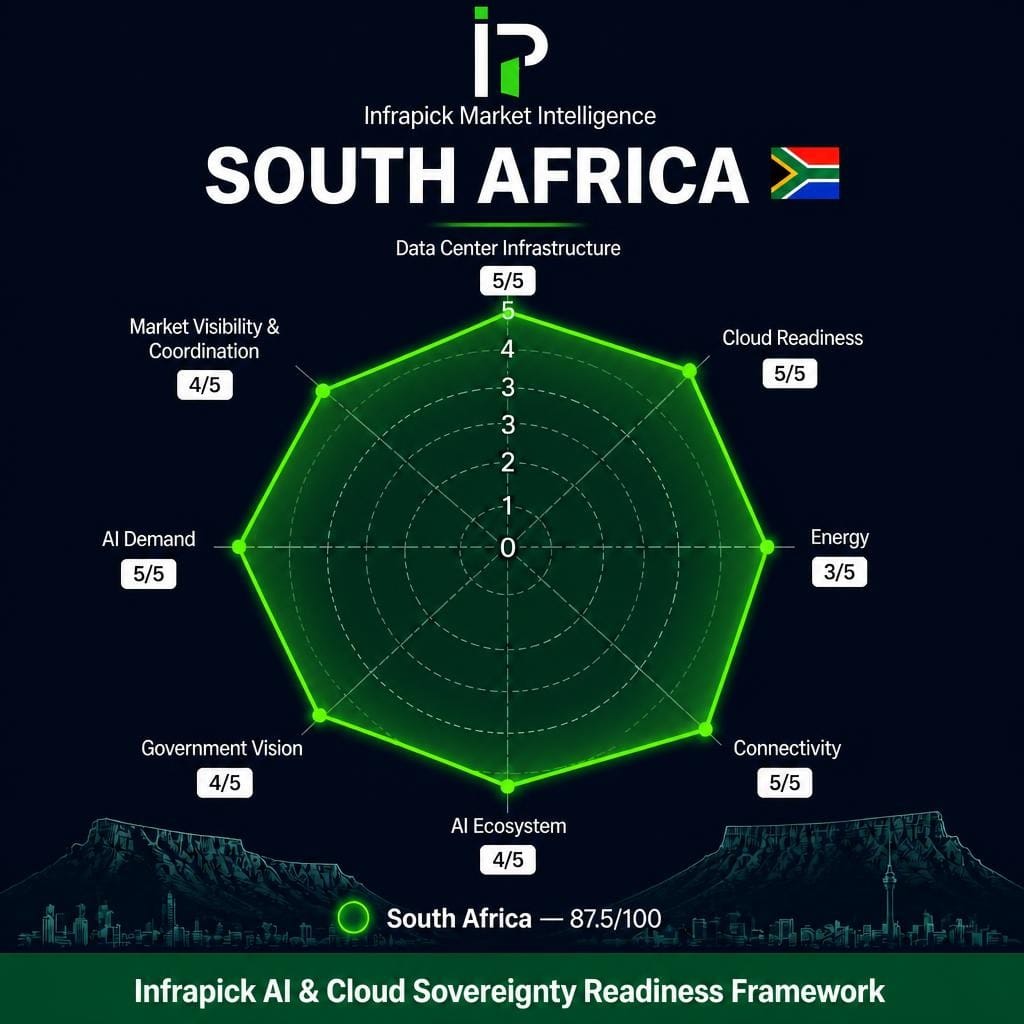
To explore this question, we applied the Infrapick AI & Cloud Sovereignty Readiness Framework, our proprietary assessment methodology introduced in our Educational Resources.
ASSESSMENT RESULTS
|
Pillar |
Score |
|
Data Center Infrastructure |
5/5 |
|
Cloud Readiness |
5/5 |
|
Energy |
3/5 |
|
Connectivity |
5/5 |
|
AI Ecosystem |
4/5 |
|
Government Vision |
4/5 |
|
AI Demand |
5/5 |
|
Market Visibility & Coordination |
4/5 |
Estimated Overall Score: 87.5/100 — Advanced
RELATED RESOURCE
ANALYSIS
Africa’s Most Mature Data Center Market
South Africa has benefited from years of investment in digital infrastructure. Today, the country hosts leading African Data Center operators, international infrastructure players, hyperscale facilities and global Cloud platforms. South Africa remains the continent's dominant Data Center hub, with a significant share of Africa's installed capacity and hyperscale Cloud deployments. The country has therefore moved well beyond the initial challenge of establishing local hosting infrastructure. Its next challenge is increasingly about scale, compute density, resilience and the infrastructure required for AI workloads.
A Mature Cloud Ecosystem
South Africa’s advantage goes beyond Data Center capacity. The country also benefits from a mature Cloud offering, significant enterprise adoption, the presence of major global Cloud providers and sufficient market depth to support continued investment.
AWS, Microsoft and Google have all established Cloud infrastructure in South Africa, with Google opening its Johannesburg region in 2024 and announcing further infrastructure and AI investments in 2026. This gives South Africa a strong foundation for the next stage of AI adoption.
Real Demand for Compute
Infrastructure investment ultimately needs a market capable of consuming the capacity being created. South Africa benefits from demand across multiple sectors such as financial services, insurance, retail, industry, telecommunications and the public sector. This diversified enterprise base creates favourable conditions for AI adoption at scale and provides a stronger commercial foundation for future AI infrastructure.
Strong Foundations in Skills and Research
South Africa also benefits from recognised universities, research capabilities, an established technology sector and a relatively mature innovation ecosystem. While its AI ecosystem remains significantly smaller than those of the world’s leading AI markets, South Africa already possesses many of the capabilities required to develop and deploy AI locally.
Recent public and private initiatives are reinforcing this direction, including investment in AI research, skills and infrastructure.
Power Remains a Strategic Constraint
Energy remains one of the most important constraints on South Africa’s ability to scale AI infrastructure. AI workloads require significantly higher power densities than conventional Data Center environments, increasing pressure on power availability, grid capacity and infrastructure resilience. Developers are already exploring renewable generation, wheeling and storage solutions to support future capacity. For South Africa, the challenge is therefore increasingly about securing sufficient, resilient and economically sustainable power for the next generation of high-density infrastructure.
RECOMMENDATION
Strategic Priority: AI First
South Africa stands apart from the other countries assessed in this series.
It already combines:
· mature Data Center infrastructure,
· established Cloud capabilities,
· significant digital demand,
· technical and research capabilities and
· strong international connectivity.
The strategic priority can therefore progressively shift from establishing digital foundations towards capturing more value from AI.
Priority investment areas could include high-performance computing capacity, GPU infrastructure, applied AI research centres, AI factories, national innovation platforms and locally developed AI applications and intellectual property.
This direction is also increasingly consistent with South Africa's own stated ambitions. In July 2026, President Cyril Ramaphosa explicitly framed the country's objective as moving beyond hosting infrastructure towards building companies, developing researchers, commercialising African ideas and creating globally competitive intellectual property.
Why Is South Africa Different?
The five assessments reveal increasingly different strategic pathways.
Benin needed to strengthen its Cloud foundations.
Senegal was better positioned for a Hybrid strategy.
Morocco could simultaneously strengthen its Cloud and AI ecosystem.
Nigeria was ready to accelerate towards AI.
South Africa is the first country in the series where the priority can credibly become AI First. At this level of maturity, the strategic issue shifts towards a different objective:
How can South Africa convert its existing digital maturity into local AI capability and economic value?
The Infrapick AI & Cloud Sovereignty Readiness Framework suggests that South Africa currently represents the closest example in this series to an AI-ready ecosystem in Africa.
Important constraints remain, particularly around power and the ability to support increasingly dense compute infrastructure.
Yet few African markets currently combine the same level of data Center maturity, Cloud availability, digital demand, technical capabilities and international connectivity.
Among the five markets assessed in this series, South Africa therefore presents the strongest case for an AI-first strategy.
ABOUT THIS ASSESSMENT
This assessment is an illustrative application of the Infrapick AI & Cloud Sovereignty Readiness Framework, based on publicly available information. It does not constitute a commissioned national assessment.
It demonstrates how a combined assessment of Data Center infrastructure, Cloud readiness, energy, connectivity, the AI ecosystem, government vision, demand, and market coordination can reveal different strategic pathways depending on a country’s level of maturity.
The detailed criteria, their weighting, and the scoring model are part of Infrapick’s proprietary methodology.
NEED A DEEPER ASSESSMENT?
Infrapick provides in-depth assessments for governments, public agencies, development institutions, and other stakeholders involved in national digital strategies.
Beyond the readiness score, a tailored assessment provides a deeper analysis of maturity gaps, dependencies, Cloud/AI sequencing, investment priorities, and potential courses of action.
Let’s discuss your objectives, your context, and the scope of a potential assessment.
ABOUT THE AUTHOR
A telecommunications engineer by training, Azimath Olayemi Adjassa has spent more than fourteen years working across digital infrastructure, telecommunications and critical environments. Her areas of interest include the intersection of connectivity, Data Centers, digital sovereignty and artificial intelligence.
She is a Data Center consultant and the founder of Infrapick, an advisory practice specializing in Data Center hosting decisions and capacity intelligence within the African infrastructure ecosystem. Her approach combines supporting organizations in making informed hosting decisions with improving the visibility of available infrastructure capacity for operators.
Her ambition is to bridge the gap between user requirements and the operational realities of the industry, while contributing to a more transparent and accessible market—one where investment, hosting and development decisions are driven by reliable data and a shared understanding of critical infrastructure challenges.