AI & Cloud Sovereignty Readiness Framework

HOW CAN WE ASSESS WETHER A COUNTRY IS READY TO BUILD CLOUD AND AI SOVEREIGNTY?
Why did we create this framework?
Discussions around digital sovereignty are gaining momentum worldwide, and particularly across Africa: Sovereign Cloud > Sovereign AI > National Data Centers > Government Cloud >AI Factories > Compute capacity. Initiatives are multiplying, but one fundamental question often remains unanswered: How do we know whether a country is actually ready to pursue Cloud or AI sovereignty? Too often, the discussion focuses on a single indicator: the number of Data Centers, the existence of a national AI strategy; the presence of a hyperscaler or the availability of power. Yet none of these factors, taken in isolation, can provide a reliable picture of an ecosystem's actual maturity. A country may have a strong AI ambition but insufficient infrastructure. It may have Data Center capacity but limited Cloud adoption. It may have connectivity and power, but insufficient demand or market coordination.
This is why Infrapick Market Intelligence developed the AI & Cloud Sovereignty Readiness Framework: a structured assessment framework designed to determine whether a country has the foundations required to support its Cloud and AI sovereignty ambitions. The objective of this framework is not to rank countries. It is to identify their strengths, areas requiring attention, and the strategic priorities most relevant to their current level of maturity.
Why a multidimensional approach?
Cloud and AI development depends on an entire value chain:
· A country can have strong Data Center infrastructure but insufficient demand.
· It can have an ambitious AI strategy but lack the infrastructure required to support it.
· It can have both infrastructure and demand while still facing fragmented policies, limited market visibility or insufficient coordination between public and private stakeholders. Cloud and AI sovereignty therefore cannot be assessed through a single indicator.
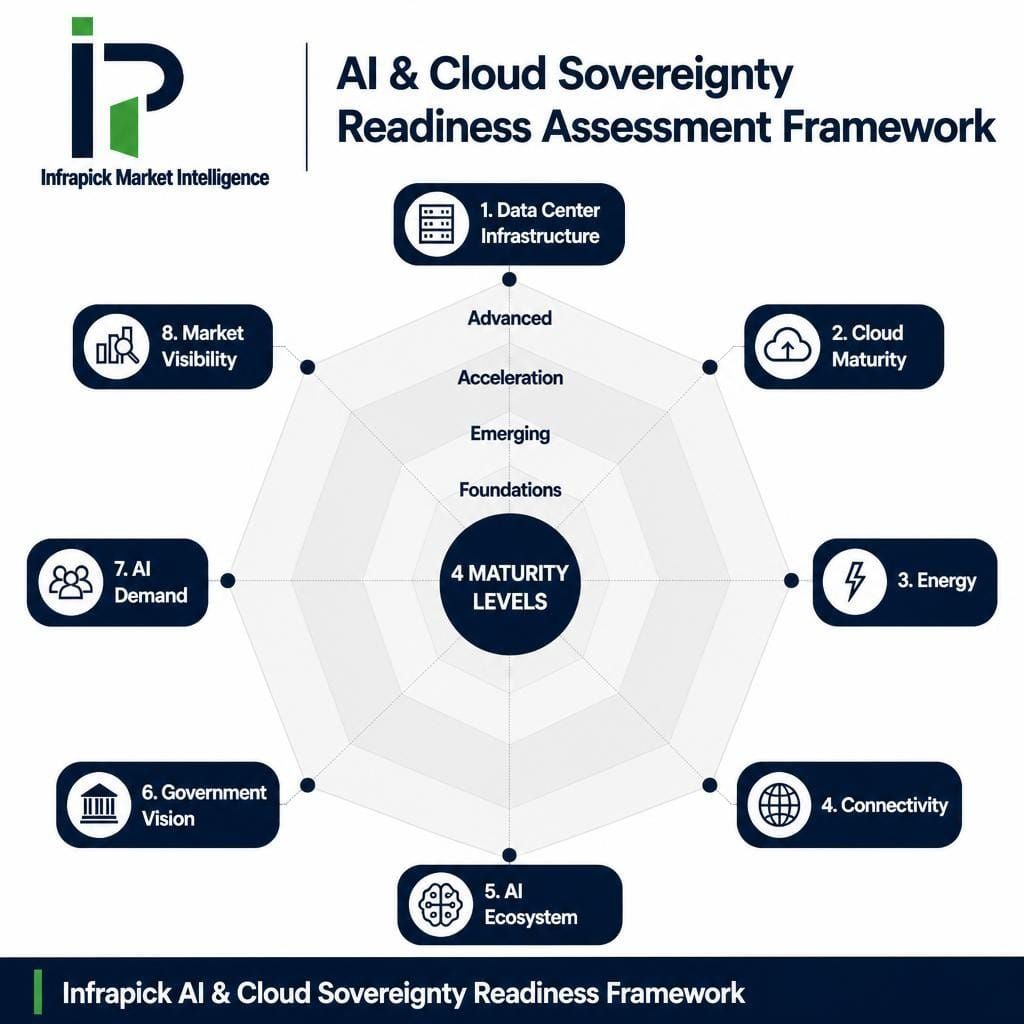
The Infrapick AI & Cloud Sovereignty Readiness Framework provides a structured view of the infrastructure, market, policy and demand conditions shaping a country's readiness, analysed across eight distinct pillars.
The Eight Pillars
1. Data Center Infrastructure Assesses the country's physical hosting capacity, colocation environment and availability of infrastructure capable of supporting local data, applications and compute requirements.
2. Cloud Readiness Examines local Cloud adoption, provider presence and the regulatory environment supporting Cloud deployment and usage.
3. Energy Assesses the availability, reliability and sustainability of power required to support digital infrastructure. 4. Connectivity Examines bandwidth, latency, fibre coverage and international interconnection.
5. AI Ecosystem Assesses talent pools, research capabilities and the local dynamics supporting AI development.
6. Government Vision Examines national strategy, policy maturity and the regulatory frameworks shaping Cloud, AI and digital infrastructure development. 7. AI Demand Assesses the appetite and potential across the public and private sectors for AI adoption and deployment. 8. Market Visibility & Coordination Examines ecosystem transparency, stakeholder alignment and the availability of market intelligence required to support informed decision-making. These eight dimensions reflect the same assessment structure used across the
Infrapick AI & Cloud Sovereignty Readiness Framework
How does the assessment work?
Each pillar is assessed through a structured set of underlying criteria. The analysis combines evidence on infrastructure, market conditions, policy, demand and ecosystem maturity to establish a readiness profile across the eight dimensions. The resulting assessment provides both: a readiness level for each pillar and an overall readiness score. The score is not intended to represent an absolute truth. It is a decision-support tool designed to identify structural gaps, dependencies and areas of relative strength, and to help determine which strategic priorities are most appropriate at a country's current stage of development. The detailed criteria, weighting methodology and scoring model form part of Infrapick's proprietary assessment methodology and are not disclosed in this public educational resource.
How should the overall score be interpreted?
The framework uses four maturity levels. Level 1 — Foundations: 0–40 The country is still building the digital and infrastructure foundations required to support meaningful Cloud and AI ambitions. Typical priority: * strengthen Data Center infrastructure; * improve connectivity; * establish foundational Cloud capabilities. Level 2 — Emerging: 41–60 Key components are beginning to emerge but remain fragmented or insufficiently mature. Typical priority: * strengthen local Cloud capabilities; * increase digital adoption; * improve ecosystem maturity and coordination. Level 3 — Accelerating: 61–80 The country has established stronger foundations and is increasingly positioned to develop Cloud and AI capabilities in parallel. Typical priority: * pursue a combined Cloud + AI approach; * strengthen compute capacity; * accelerate AI innovation and adoption; * improve alignment between policy and market dynamics. Level 4 — Advanced: 81–100 The ecosystem has sufficiently strong foundations and enabling conditions to support more ambitious sovereign AI capabilities. Typical priority: * advanced AI infrastructure; * AI Factories; * sovereign AI models and services; * advanced compute capabilities. Each maturity level therefore points towards a different set of strategic priorities. The purpose of the assessment is to determine where a country stands and which actions matter most at that stage.
What can the framework be used for?
The framework can support governments, public agencies, development institutions, investors and other stakeholders seeking to better understand a country's Cloud and AI infrastructure readiness. It can be used to: * assess a country's current level of readiness; * identify the main barriers to Cloud or AI development; * highlight structural dependencies between infrastructure, policy, market and demand; * identify priority areas for public or private investment; * inform national digital sovereignty strategies; * support discussions between governments, infrastructure operators, investors and other ecosystem stakeholders; * provide a consistent basis for comparing readiness across different markets. The purpose is not simply to produce a score. The value lies in understanding what sits behind that score and what it means for the country's next strategic decisions.
Sovereign Cloud or Sovereign AI?
This is ultimately one of the central questions the framework is designed to help address. Not every country that wants sovereign AI is necessarily ready to build it at scale. In some markets, the immediate priority may be to strengthen local hosting capacity, Cloud adoption, connectivity or power infrastructure. In others, those foundations may already be sufficiently mature to justify greater investment in compute capacity, AI infrastructure and sovereign AI capabilities. The question is therefore not “Should this country pursue sovereign Cloud or sovereign AI?” A more useful question is: “Which ambition is consistent with the country's current level of maturity — and which foundations need to be built to reach the next stage?” This is why the framework does not rank countries against one another. It helps identify the most appropriate development trajectory by highlighting structural gaps and enabling conditions that determine what is achievable, and in what sequence.
What comes next?
The framework provides the analytical foundation. Its real value becomes clearer when applied to real-world situations. Through our Use Cases, Infrapick Insigths applies this approach to different African markets to explore how different levels of maturity can lead to different priorities across Cloud, AI and digital infrastructure. For example, our public assessment of Benin Republic resulted in an estimated overall readiness score of 52/100 — Emerging, with the strategic conclusion that strengthening Cloud sovereignty should remain a priority while the country continues building the foundations required for future AI sovereignty. Want to be among the first to discover our upcoming country Use Cases? Subscribe to Infrapick Insights.
Need a depper assessment?
This resource presents the principles and eight pillars of the Infrapick AI & Cloud Sovereignty Readiness Framework. The full application of the framework is available through commissioned assessments for governments, public agencies, development institutions and other stakeholders involved in national digital strategies. Using its proprietary methodology, Infrapick conducts in-depth readiness assessments designed to identify maturity gaps and dependencies, determine Cloud vs AI strategic sequencing, highlight priority investment areas and translate the findings into strategic recommendations and an actionable roadmap. A commissioned assessment can include, depending on scope: * in-depth analysis across all eight pillars; * evidence-based readiness assessment; * gap and dependency analysis; * Cloud vs AI strategic sequencing; * strategic recommendations and priority investment areas; * actionable roadmap; * executive report and stakeholder presentation. In other words, the public framework and Use Cases provide visibility into where a country may stand. A commissioned assessment examines why and what should happen next. Let's discuss your objectives, context and the appropriate scope for an assessment.
About the Author
A telecommunications engineer by training, Azimath Olayemi Adjassa has spent more than fourteen years working across digital infrastructure, telecommunications and critical environments. Her areas of interest include the intersection of connectivity, Data Centers, digital sovereignty and artificial intelligence.
She is a Data Center consultant and the founder of Infrapick, an advisory practice specializing in Data Center hosting decisions and capacity intelligence within the African infrastructure ecosystem. Her approach combines supporting organizations in making informed hosting decisions with improving the visibility of available infrastructure capacity for operators.
Her ambition is to bridge the gap between user requirements and the operational realities of the industry, while contributing to a more transparent and accessible market—one where investment, hosting and development decisions are driven by reliable data and a shared understanding of critical infrastructure challenges.