CLOUD SOVEREIGNTY OR AI SOVEREIGNTY? USE CASE #4 — NIGERIA: IS SOVEREIGN AI THE NEXT FRONTIER?

With a population of more than 220 million, Nigeria is Africa’s largest domestic digital market. The country combines several assets that few African markets have at the same scale:
· multiple world-class Data Centers,
· some of West Africa’s largest telecom operators,
· one of the continent’s most dynamic startup ecosystems,
· significant investment in digital infrastructure,
· strong demand from financial services, energy, logistics and e-commerce.
Nigeria has also become one of Africa’s leading destinations for Data Center investment.
This raises an important strategic question: Should Nigeria continue to prioritise Cloud development, or is the country ready to move towards sovereign AI capabilities?
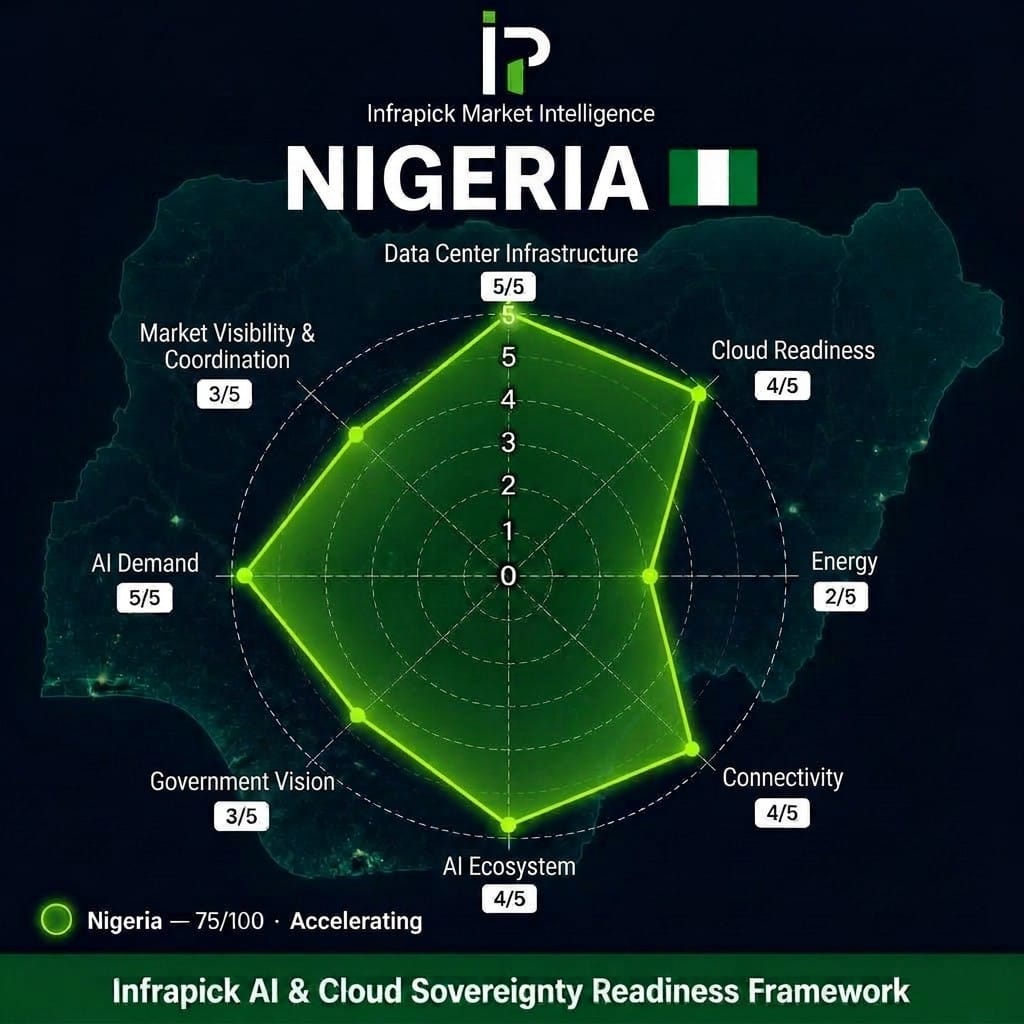
To explore this question, we applied the Infrapick AI & Cloud Sovereignty Readiness Framework, our proprietary assessment methodology introduced in our Educational Resources.
ASSESSMENT RESULTS
|
Pillar |
Score |
|
Data Center Infrastructure |
5/5 |
|
Cloud Readiness |
4/5 |
|
Energy |
2/5 |
|
Connectivity |
4/5 |
|
AI Ecosystem |
4/5 |
|
Government Vision |
3/5 |
|
AI Demand |
5/5 |
|
Market Visibility & Coordination |
3/5 |
Estimated overall score: 75/100 — Accelerating
This places Nigeria firmly in the Accelerating maturity stage: the foundations are increasingly established, but several structural constraints still need to be addressed before the country can fully capture the value of sovereign AI infrastructure.
RELATED RESOURCE
ANALYSIS
Strong digital foundations are already in place
Nigeria has the most developed Data Center market in West Africa. The country hosts international operators, large-scale colocation infrastructure, Cloud players and a growing pipeline of expansion projects. As a result, developing basic local hosting capacity is no longer the market's primary structural gap. The discussion is increasingly shifting towards the scale, resilience and type of infrastructure required for the next phase of digital growth.
Demand provides a credible foundation for AI investment
One of Nigeria’s strongest advantages is the depth of its domestic digital market. Demand for advanced digital infrastructure already comes from banks and financial institutions, fintech companies, e-commerce platforms, telecom operators, public institutions and technology startups.
This matters enormously for AI infrastructure. GPU clusters and AI-ready Data Centers require substantial capital, power and specialised infrastructure. Their long-term viability therefore depends on the existence of users capable of generating sustained demand. Nigeria already has a considerable domestic market from which that demand can emerge.
One of Africa’s most dynamic AI ecosystems
Nigeria hosts a significant share of Africa’s technology startups, while AI adoption is expanding across sectors including finance, healthcare, education, cybersecurity and digital services. This ecosystem is gradually creating the conditions for greater demand for local compute capacity. The opportunity is therefore not limited to hosting infrastructure. It also lies in connecting infrastructure, compute, talent, applications and market demand.
Energy remains the critical constraint
This is where Nigeria’s readiness profile becomes particularly interesting. The country does not primarily lack market demand, digital entrepreneurship or Data Center development. Its most significant structural constraint is power.
AI infrastructure will increase requirements for available electrical capacity, resilient power supply, higher-density infrastructure, advanced cooling capabilities. Nigeria’s ability to solve this constraint will have a major influence on how quickly the country can scale AI infrastructure economically and sustainably.
Coordination still needs to improve
Despite Nigeria’s relative maturity, the ecosystem remains fragmented. AI, Cloud, Data Center and energy initiatives do not always progress at the same pace or within a common infrastructure strategy. The next stage of development will therefore require stronger coordination between government, Data Center operators, Cloud providers, investors, energy stakeholders and AI ecosystem players.
Better market visibility will also become increasingly important as investment decisions depend on understanding not only existing infrastructure, but also future capacity, demand and project pipelines.
Sovereignty still depends heavily on imported technologies
Nigeria’s digital ecosystem continues to rely significantly on technologies developed and controlled outside the country.
AI hardware, Cloud platforms, foundation models and much of the underlying technology stack remain largely supplied by international players. The next phase is therefore about more than deploying additional infrastructure. It is also about increasing the country’s ability to create, operate and capture value locally across the AI value chain.
RECOMMENDATION
Strategic Priority: AI Acceleration
The Infrapick AI & Cloud Sovereignty framework suggests that Nigeria should continue strengthening its Cloud capabilities while progressively directing more strategic investment towards AI infrastructure and local AI capabilities.
Priority areas could include:
· AI compute infrastructure;
· GPU clusters;
· National AI innovation platforms;
· Applied research programmes;
· Models adapted to African languages and use cases;
· Higher-value AI services.
Why not focus exclusively on Cloud?
Nigeria has reached a stage where Cloud expansion alone may not fully capture the opportunity ahead.
The country already combines several assets required to move further up the digital value chain: a large domestic market, technology talent, Data Center infrastructure, entrepreneurial activity and investor interest.
The strategic opportunity is to use those foundations to develop greater local capability in AI rather than remaining predominantly a consumer of technologies created elsewhere. Nigeria therefore illustrates an important distinction between Cloud maturity and AI maturity.
For years, the priority was to build the digital infrastructure required to support a rapidly expanding digital economy. That process is now well underway. The Infrapick AI & Cloud Sovereignty Readiness Framework suggests that Nigeria is entering a new phase. Cloud remains a critical foundation. But the country now has an opportunity to progressively turn its existing digital infrastructure into local AI capability, innovation and economic value.
The next frontier may no longer be simply hosting more digital infrastructure. It may be determining how much of the value created on top of that infrastructure Nigeria can capture locally.
ABOUT THIS ASSESSMENT
This assessment is an illustrative application of the Infrapick AI & Cloud Sovereignty Readiness Framework, based on publicly available information. It does not constitute a commissioned national assessment.
It demonstrates how a combined assessment of Data Center infrastructure, Cloud readiness, energy, connectivity, the AI ecosystem, government vision, demand, and market coordination can reveal different strategic pathways depending on a country’s level of maturity.
The detailed criteria, their weighting, and the scoring model are part of Infrapick’s proprietary methodology.
NEED A DEEPER ASSESSMENT?
Infrapick provides in-depth assessments for governments, public agencies, development institutions, and other stakeholders involved in national digital strategies.
Beyond the readiness score, a tailored assessment provides a deeper analysis of maturity gaps, dependencies, Cloud/AI sequencing, investment priorities, and potential courses of action.
Let’s discuss your objectives, your context, and the scope of a potential assessment.
ABOUT THE AUTHOR
A telecommunications engineer by training, Azimath Olayemi Adjassa has spent more than fourteen years working across digital infrastructure, telecommunications and critical environments. Her areas of interest include the intersection of connectivity, Data Centers, digital sovereignty and artificial intelligence.
She is a Data Center consultant and the founder of Infrapick, an advisory practice specializing in Data Center hosting decisions and capacity intelligence within the African infrastructure ecosystem. Her approach combines supporting organizations in making informed hosting decisions with improving the visibility of available infrastructure capacity for operators.
Her ambition is to bridge the gap between user requirements and the operational realities of the industry, while contributing to a more transparent and accessible market—one where investment, hosting and development decisions are driven by reliable data and a shared understanding of critical infrastructure challenges.