Nigeria’s New Cloud Guideline: 5 Things Data Center Operators & Investors Should Watch

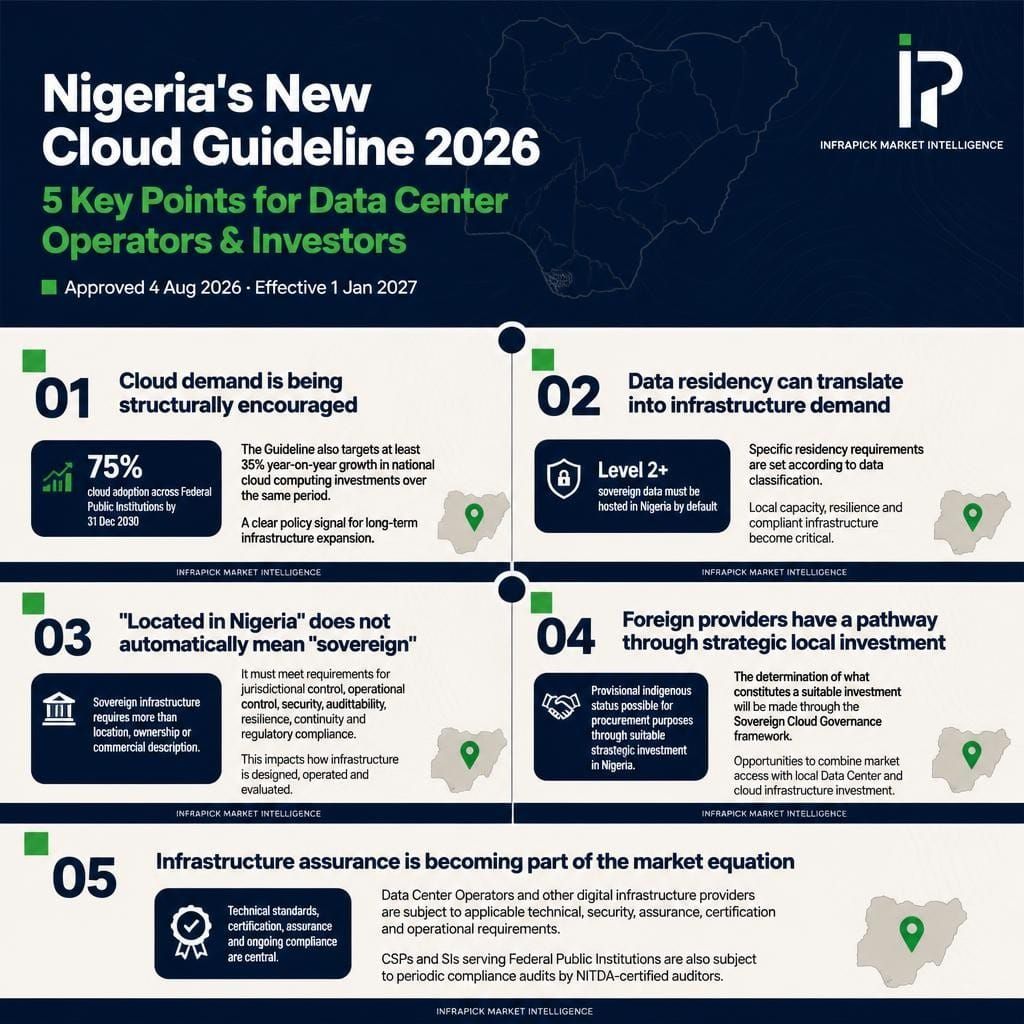
Nigeria has just published its National Cloud Computing Guideline 2026. It was approved on 4 August 2026 and will become effective on 1 January 2027. And it goes far beyond cloud procurement. For Data Center operators and investors, here are 5 points worth paying attention to.
1️ CLOUD DEMAND IS BEING STRUCTURALLY ENCOURAGED
The Guideline sets a target of 75% cloud adoption across Federal Public Institutions by 31 December 2030 and aims to stimulate sustained year-on-year growth of at least 35% in national cloud computing investments over the same period.
These are national policy objectives, but they send a clear signal about the direction of Nigeria’s digital infrastructure market.
For investors, the question is therefore not only about today's demand — but about the infrastructure required to support this planned expansion.
2️ DATA RESIDENCY CAN TRANSLATE INTO INFRASTRUCTURE DEMAND
All sovereign data classified Level 2 and above is to be hosted in Nigeria by default, subject to specific requirements and limited waivers.
The Guideline also establishes specific residency requirements according to data classification.
For Data Center operators, this makes local capacity, resilience and compliant infrastructure increasingly relevant to the cloud market.
3️ “LOCATED IN NIGERIA” DOES NOT AUTOMATICALLY MEAN “SOVEREIGN”
This may be one of the most important points for infrastructure investors to understand.
The Guideline explicitly states that infrastructure cannot be considered sovereign solely because of its physical location, ownership structure or commercial description.
Sovereign infrastructure must also satisfy requirements relating to jurisdictional control, operational control, security, auditability, resilience, continuity and regulatory compliance.
That has direct implications for how infrastructure is designed, operated and evaluated.
4️ FOREIGN PROVIDERS HAVE A PATHWAY THROUGH STRATEGIC LOCAL INVESTMENT
The Guideline gives foreign Cloud Service Providers a potential route to provisional indigenous status for procurement purposes where they make suitable strategic investments in Nigeria.
The determination of what constitutes a suitable investment will be made through the Sovereign Cloud Governance framework.
For international players, this could create opportunities to combine market access with local Data Center and cloud infrastructure investment.
5️ INFRASTRUCTURE ASSURANCE IS BECOMING PART OF THE MARKET EQUATION
The Guideline places significant emphasis on technical standards, certification, assurance and ongoing compliance.
Data Center Operators and other digital infrastructure providers within scope are subject to applicable technical, security, assurance, certification and operational requirements.
For CSPs and SI’s serving Federal Public Institutions, periodic compliance audits by NITDA-certified auditors are also mentionned.
For operators and investors, infrastructure quality is therefore increasingly connected not only to operational performance, but also to regulatory readiness and market access.
THE BIGGER PICTURE
This Guideline should not be read only as a cloud regulation. It is also a signal about the direction of Nigeria’s digital infrastructure ecosystem:
For investors and operators, the question is no longer simply : “How much Data Center capacity does Nigeria need?” It is increasingly: “What type of infrastructure will Nigeria’s next phase of digital and AI growth require?” That is where infrastructure intelligence becomes critical.
Source: National Cloud Computing Guideline 2026 — National Information Technology Development Agency (NITDA).
RELATED SERVICE : INFRAPICK SITE INTELLIGENCE
From site screening to informed due diligence.
Selecting a data center location should not begin with commissioning every detailed study on every potential site. Our Site Intelligence service is designed for organisations that need to move from “Where can we host or build?” to “Which options are genuinely worth investigating — and what evidence do we need before we commit?”
· Infrapick Site Intelligence helps investors, operators and organisations identify which locations and facilities warrant deeper investigation by bringing together critical infrastructure, connectivity, environmental, land and regulatory information into a structured screening framework.
· Our approach is designed to answer an essential question before significant due diligence costs are committed: Which sites deserve to move to the next stage — and what still needs to be verified?
Infrapick's approach connects three stages:
1. Site IntelligenceWe collect, structure and qualify information on power infrastructure, connectivity, flood and environmental risks, land and accessibility, and regulatory conditions.
2. Site Screening
Candidate locations are assessed against the client's specific requirements, highlighting strengths, constraints, data gaps and potential red flags.
3. Due Diligence Roadmap
For shortlisted sites, Infrapick identifies the key points requiring formal validation and helps define the appropriate next investigations, specialist studies and technical confirmations. This may include areas such as grid connection feasibility, physical fibre-route diversity, geotechnical assessment, environmental assessment, land and title verification, permitting and other site-specific investigations.
Building infrastructure intelligence in Africa
To strengthen this capability, Infrapick's research team is currently building a structured infrastructure intelligence dataset across four priority development corridors in the Lagos–Ogun area.
The research covers:
· Power infrastructure
· Fibre and connectivity
· Flood and natural risk
· Land, infrastructure and accessibility
· Regulatory and environmental conditions
The objective is not simply to create a database of data centers. It is to build a deeper understanding of the infrastructure conditions that make a location viable for future data center development. As the dataset expands, this intelligence can support faster and more evidence-based site screening across African markets.
ABOUT THE AUTHOR
A telecommunications engineer by training, Azimath Olayemi Adjassa has spent more than twelve years working across digital infrastructure, telecommunications and critical environments. Her areas of interest include the intersection of connectivity, Data Centers, digital sovereignty and artificial intelligence.
She is a Data Center consultant and the founder of Infrapick, an advisory practice specializing in Data Center hosting decisions and capacity intelligence within the African infrastructure ecosystem. Her approach combines supporting organizations in making informed hosting decisions with improving the visibility of available infrastructure capacity for operators.
Her ambition is to bridge the gap between user requirements and the operational realities of the industry, while contributing to a more transparent and accessible market—one where investment, hosting and development decisions are driven by reliable data and a shared understanding of critical infrastructure challenges.