Nigeria’s 2026 Cloud Computing Guideline: 5 Things Cloud & Data Center Providers Need to Know

Nigeria’s National Cloud Computing Guideline 2026 is not simply a framework for government cloud adoption.
For Cloud Service Providers, Data Center Operators and other technology service providers, it introduces a clearer set of expectations around compliance, data residency, infrastructure, security, resilience and service delivery.
The Guideline becomes effective on 1 January 2027.
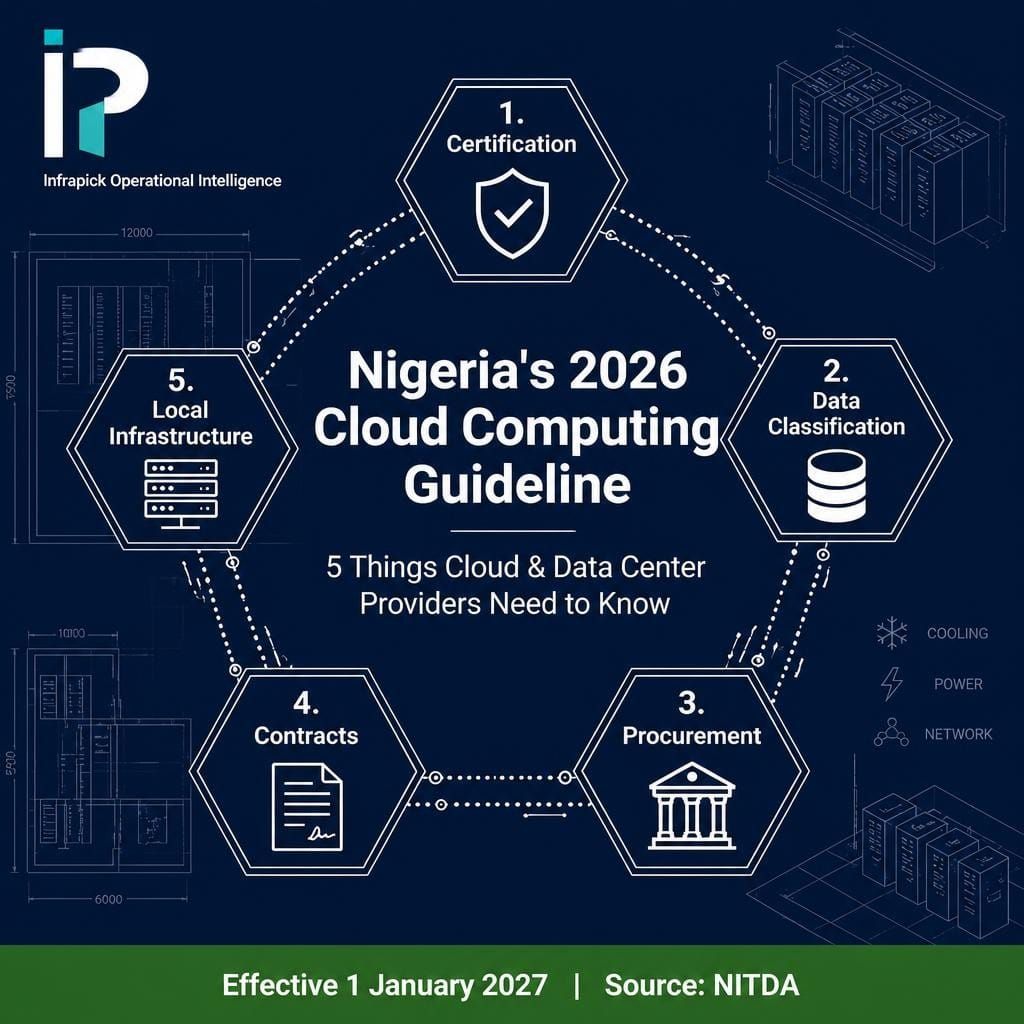
Here are five points providers should be paying attention to.
1️⃣ Certification and compliance are becoming part of the market equation
The Guideline places significant emphasis on standards, certification, assurance and compliance.
Providers serving Federal Public Institutions will increasingly need to demonstrate that their infrastructure and services meet applicable technical, security and operational requirements.
This means compliance should not be treated simply as a regulatory exercise.
For providers competing for government and regulated-sector business, the ability to demonstrate compliance can increasingly become part of the value proposition itself.
The practical question is: Can you demonstrate that your infrastructure, processes and services are ready to meet Nigeria's evolving cloud requirements?
2️⃣ Data classification will directly affect where and how you host
One of the most important changes for providers is the relationship between data classification and hosting requirements.
Nigeria's framework establishes different levels of data sensitivity, with stronger residency and protection requirements applying to higher classifications.
For providers, this means that the question is no longer simply: “Where is your Data Center?” It becomes: “What type of data can you host, where can it be hosted, under whose jurisdiction and with what level of control?”
This has direct implications for:
- Data Center location
- Cloud architecture
- Infrastructure ownership and control
- Security controls
- Disaster recovery
- Data replication
- Backup locations
- Cross-border data transfers
Providers operating in Nigeria will therefore need to understand not only their infrastructure footprint, but also how that footprint aligns with the different categories of data they intend to serve.
3️⃣ Government procurement is becoming more strategically important
The Guideline establishes a stronger preference for indigenous Cloud Service Providers in the procurement of cloud services by Federal Public Institutions.
At the same time, foreign providers have a potential pathway to provisional indigenous status through suitable strategic investment in Nigeria. This creates an interesting competitive dynamic.
For international providers, entering the Nigerian market may increasingly require more than simply selling services remotely.
Local infrastructure, local partnerships and measurable investment can become commercially relevant.
For indigenous providers, meanwhile, the new framework could create an opportunity to strengthen their position in the government cloud market.
The strategic question for providers is therefore: Are you simply selling cloud services in Nigeria, or are you building a long-term infrastructure and market presence in Nigeria?
4️⃣ Cloud contracts will need stronger resilience, portability and exit provisions
The Guideline also has important implications beyond infrastructure. Cloud agreements serving government and regulated environments are expected to address areas such as:
- Service Level Agreements
- Security responsibilities
- Business continuity
- Disaster recovery
- RTO and RPO
- Incident management
- Data portability
- Exit arrangements
- Data return, transfer or deletion
One particularly important principle is avoiding vendor lock-in.
Providers should therefore be prepared to support structured exit and portability arrangements rather than treating migration away from the platform as an afterthought. For customers, this provides greater control.
For providers, it means that portability and exit should be designed into the service architecture and contract from the beginning.
5️⃣ Local infrastructure can become a competitive advantage
The Guideline's direction on sovereignty, residency, resilience and indigenous participation creates an increasingly strong case for local infrastructure investment.
For Data Center Operators, this can translate into opportunities around:
- Sovereign hosting
- Government cloud
- Colocation
- Private cloud
- Disaster recovery
- Local cloud regions
- AI compute infrastructure
- Capacity expansion
But simply adding more racks or more megawatts will not necessarily be enough.
The infrastructure needs to be aligned with the type of workloads, data classifications and customers the market is expected to serve. That makes infrastructure planning increasingly strategic.
WHAT PROVIDERS SHOULD BE ASKING NOW?
The Guideline becomes effective in January 2027. That gives providers time to assess their current position. Five questions are worth asking:
1. Is our infrastructure aligned with the data classifications we intend to serve?
2. Can we demonstrate the required level of security, resilience and operational control?
3. Are our contracts ready for stronger portability and exit requirements?
4. Does our Nigerian infrastructure footprint support our target market?
5. Are we positioned to benefit from the growing demand for sovereign and locally hosted cloud infrastructure?
THE BIGGER PICTURE
Nigeria's cloud market is entering a more structured phase.
The opportunity is no longer simply about providing cloud capacity. It is increasingly about providing infrastructure that is:
For Cloud Service Providers and Data Center Operators, the winners may ultimately be those that can combine technical capability with regulatory readiness and local infrastructure intelligence.
The 2026 Guideline therefore deserves to be read not only as a compliance document, but also as a market signal.
Source: National Cloud Computing Guideline 2026 — National Information Technology Development Agency (NITDA).
Is your infrastructure ready for the next phase of Nigeria’s cloud market?
Regulatory requirements are evolving. Infrastructure is expanding. Customers increasingly expect greater visibility, resilience and operational control. But you can only make the right decisions when you can trust the information you have about your own infrastructure.
RELATED INFRAPICK SERVICE: Operational Intelligence
Transform infrastructure knowledge into operational confidence.
Infrapick helps Data Center operators and infrastructure organizations maintain accurate, structured and actionable infrastructure knowledge — from asset and capacity visibility to documentation, infrastructure layouts and operational data.
Our approach helps you answer critical questions:
- Does your documentation reflect your actual infrastructure?
- Can your teams rely on the data behind operational decisions?
- Do you have accurate visibility of your available capacity?
- Is critical infrastructure knowledge structured and accessible?
- Can your organization confidently support growth, compliance and customer requirements?
Build confidence in the infrastructure you operate.
Assess Your Infrastructure Project
Planning a Data Center project, capacity expansion or cloud infrastructure strategy?
Book a free 25-minute Discovery Call with an Infrapick expert to discuss your project, your priorities and the most relevant next step.
ABOUT THE AUTHOR
A telecommunications engineer by training, Azimath Olayemi Adjassa has spent more than twelve years working across digital infrastructure, telecommunications and critical environments. Her areas of interest include the intersection of connectivity, Data Centers, digital sovereignty and artificial intelligence.
She is a Data Center consultant and the founder of Infrapick, an advisory practice specializing in Data Center hosting decisions and capacity intelligence within the African infrastructure ecosystem. Her approach combines supporting organizations in making informed hosting decisions with improving the visibility of available infrastructure capacity for operators.
Her ambition is to bridge the gap between user requirements and the operational realities of the industry, while contributing to a more transparent and accessible market—one where investment, hosting and development decisions are driven by reliable data and a shared understanding of critical infrastructure challenges.
#CloudComputing #DataCenters #Nigeria #DigitalInfrastructure #CloudInfrastructure #DataSovereignty #CloudSecurity #InfrastructureInvestment